
Understanding Your Nonverbal Autistic Child: What “Nonverbal” Really Means and How to Communicate Better
Understanding your nonverbal autistic child can feel overwhelming. Learn what “nonverbal” really means and how to build a deep connection beyond words.
2/17/20264 min read

There is a kind of quiet that only autism parents understand.
It is the quiet where your child doesn’t say “Mom.”
Doesn’t say “I’m hungry.”
Doesn’t say “I love you.”
And if we are being honest, sometimes that silence feels heavy.
Not because they have nothing to say.
But because you are desperate to understand what is already there.
If your child is nonverbal or minimally verbal, I want you to know something right away. You are not alone in this. I live this every day with my son. I know the guessing game. I know the mental gymnastics of trying to decode whether that look means “snack,” “overstimulated,” or “why did you give me the blue cup instead of the green one.”
Yes, the cup colour matters. Tremendously.
And somewhere between the guessing and the googling, we start to wonder if we are missing something important.
Let me gently say this.
Communication is still happening.
It just does not always sound the way the world expects it to.
What Does “Nonverbal” Actually Mean?
When people hear “nonverbal,” they often assume it means a child does not understand language. That is simply not true.
Within Autism spectrum disorder, communication differences vary widely. Some children do not use spoken words at all. Some use a few. Some understand everything but cannot coordinate their mouth to produce speech consistently.
That is where the term “nonspeaking” comes in. Many families prefer it because it shifts the focus. It suggests that the issue is with speech production, not comprehension.
And that distinction matters.
Because lack of speech does not equal lack of understanding.
It does not equal lack of intelligence.
It absolutely does not equal lack of emotion.
There have been so many moments where I have realized my son understood far more than I gave him credit for. A reaction to something said days earlier. A shift in mood when a routine changed. A smile at a familiar phrase.
They are listening. They are absorbing. Even when they are quiet.
Communication Is Still Happening. You Just Have to Learn the Language.
Here is the sentence that changed everything for me.
Behaviour is communication.
That sudden meltdown in the grocery store. Communication.
That pulling your hand toward the pantry. Communication.
That full-body flop onto the floor when you turn off the tablet. Also, communication, even if it feels dramatic enough for Broadway.
Sometimes I joke that autism parents deserve honorary detective badges. We notice patterns in eyebrow twitches and breathing changes. We can tell the difference between “tired cry” and “overwhelmed cry” from across the room.
My son might not say, “I would like a snack now.”
But he will take my hand, lead me to the kitchen, look at the cupboard, then back at me. That is a full sentence.
Eye gaze shifts. Body tension. Increased stimming. Withdrawal. Those are words.
When you start viewing communication this way, the silence feels less like absence and more like translation.
Understanding Emotions Without Words
This is the part that keeps many of us up at night.
What if they are sad and I do not see it?
What if they are anxious and I miss the signs?
What if they feel misunderstood?
First, take a breath. You are not failing at this. You are learning in real time.
Start noticing patterns.
What happens before frustration builds?
Is there a certain sound, light, or time of day that consistently leads to dysregulation?
Are transitions harder than you realized?
I began narrating emotions out loud without expecting a response.
“You’re frustrated.”
“That was loud.”
“You wanted more time.”
“You’re tired.”
No pressure. No demands for eye contact. Just modelling language.
Sometimes it feels like I am commentating a very intense toddler documentary. But over time, those words become anchors. Even if they never repeat them back to you, they are connecting the dots.
You are helping them name feelings they may not yet be able to express.
AAC Is Not Giving Up. It Is Opening Doors.
AAC stands for Augmentative and Alternative Communication. It simply means tools that support communication beyond speech.
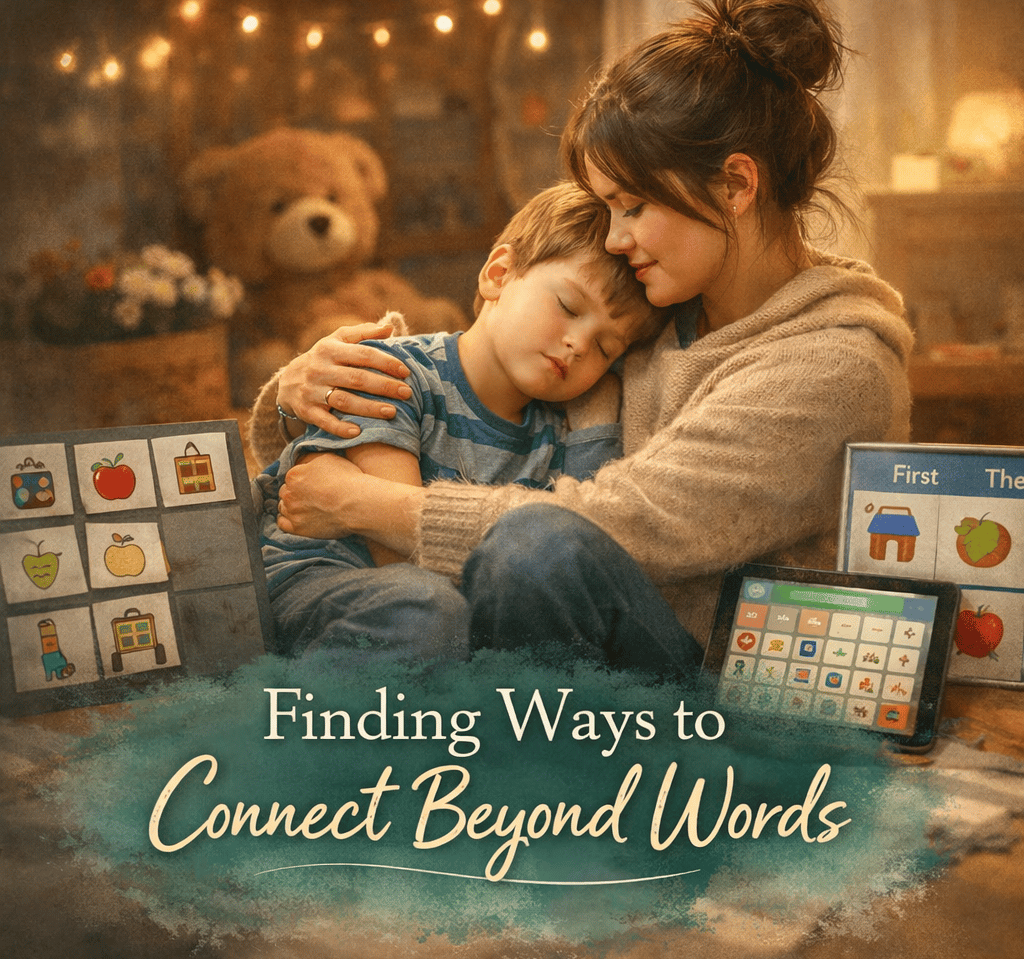
Picture cards. Communication boards. Tablet-based speech apps. Visual schedules.
These tools do not replace connection. They support it.
And using AAC does not prevent speech development. Research has shown the opposite. When children have access to communication tools, frustration decreases, and language often grows.
The first time a device speaks a word your child selected, it can feel overwhelming in the best way. It is not just a sound. It is proof. Proof that their thoughts were always there.
Giving your child another way to communicate is not lowering expectations. It is meeting them where they are.
Connection Does Not Require Words
This is the part I want you to sit with.
My son may never say “I love you.”
But he rests his head on my shoulder when he is tired.
He brings me his favourite toy when he wants to sit near me.
He laughs in a way that fills the entire room when he feels safe.
That is love.
We are taught that communication equals conversation. It does not. It equals understanding. It equals safety. It equals presence.
Sometimes the connection we build without words is quieter, but it is also incredibly deep. It requires patience. It requires observation. It requires slowing down enough to notice.
If you are in this season, wondering if they understand you, wondering if you are doing enough, wondering if the silence will ever change, please hear this from another mom walking the same path.
They understand more than you think.
They feel more than you realize.
And you are doing better than you give yourself credit for.
You are not parenting in silence.
You are learning a new language. Together. 💚