
Visual Schedule Tools That Help Autistic Kids Feel Safer When Routines Change
When routines suddenly change, many autistic children can feel confused or overwhelmed. Visual schedules can help bring predictability back into the day by showing children what comes next. In this post, I share a few simple visual tools that can help autistic kids feel safer and more supported when daily routines shift.
3/17/20265 min read

Routine can feel like a quiet superpower for many autistic children.
When the day follows a familiar rhythm, everything seems to flow a little more smoothly. Mornings feel calmer. Transitions feel easier. Even the mood in the house can feel lighter.
But then life does what life does best… it changes the plan.
Maybe it’s March Break.
Maybe school closes unexpectedly.
Maybe an appointment runs late.
Suddenly the day that was supposed to unfold in a familiar way looks completely different.
If you’re parenting an autistic child, you’ve probably seen the moment when that change hits. The confusion. The frustration. The sense that the day has suddenly lost its structure.
Many autism parents recognize these moments immediately:
• their child pacing or looking unsure about what to do next
• pointing to familiar school items like backpacks or shoes
• becoming upset when the usual routine disappears
• asking for reassurance about what is happening next
I’ve seen it with my own son more times than I can count.
When the routine shifts, it’s almost like his brain is trying to quickly rebuild the map of the day.
What’s happening now?
What comes next?
Why is this different?
And that’s when I discovered something surprisingly simple that can make a big difference.
Sometimes kids just need to see the plan, not only hear it.
That’s where visual schedules can become incredibly helpful.
Why Visual Schedules Work So Well for Autistic Kids
Many autistic children process information visually. Words can disappear quickly, but pictures stay long enough for the brain to organize them.
Think about how often we say things like:
“First breakfast, then we’ll get dressed.”
For some children, that sentence can feel like it disappears before they have a chance to fully process it.
But when the plan is visible, something shifts.
Suddenly the day becomes something they can see, understand, and prepare for.
Visual schedules can help children:
• understand what comes next
• reduce anxiety around transitions
• feel more secure during schedule changes
• move through the day more smoothly
And honestly, they can help parents stay organized too.
A Gentle Note
Before I share a few tools that many autism families find helpful, I want to take a moment to be transparent.
Some of the links below may be affiliate links. This simply means that if you decide to purchase through one of them, I may earn a small commission at no extra cost to you.
I’m a single mom raising my children, including my autistic son, while building this little corner of the internet. Between parenting, writing, and working on this blog and other small ventures, I’m doing my best to create something meaningful that can also help support our family.
Every time you read a post, share an article, or choose to purchase through one of these links, it truly helps keep this space going.
More than anything, I hope the ideas I share here make your days a little easier and remind you that you’re not alone on this journey. 💚
A Simple Tool That Helps Kids Understand “First and Then”
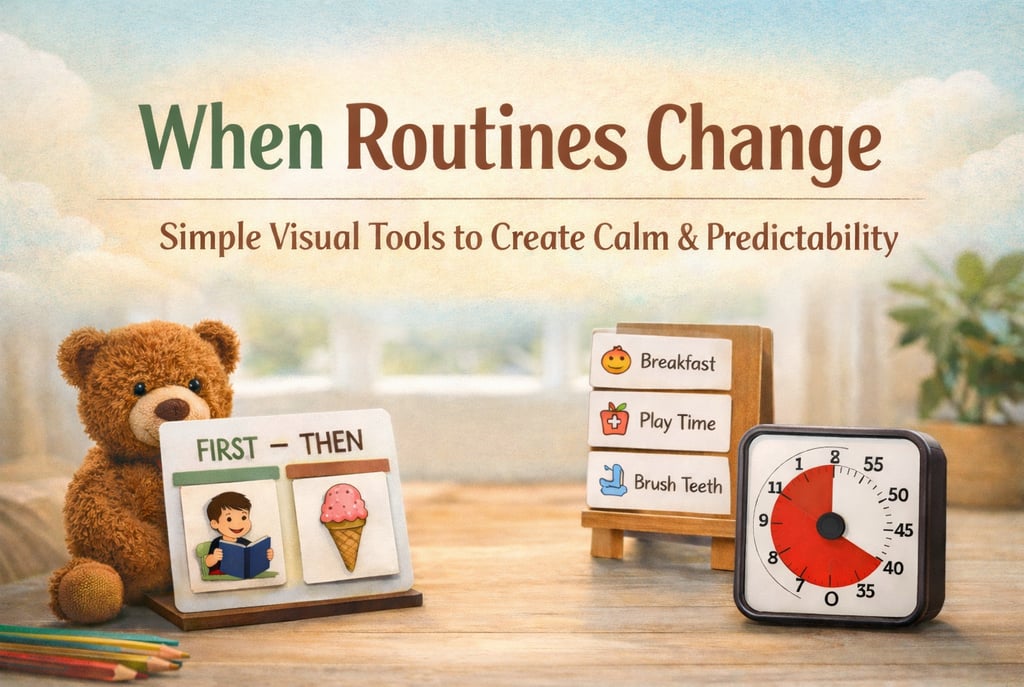
One of the easiest visual supports to introduce is something called a First–Then board.
These boards show two simple steps:
First → the task that needs to happen
Then → the activity your child is looking forward to.
For example:
First: get dressed
Then: play with toys.
This simple structure helps children understand that the preferred activity is still coming, which can make transitions feel much less overwhelming.
Many parents find tools like the First-Then Visual Schedule Board for Kids especially helpful because they are small, portable, and easy to use throughout the day.
Whether you’re getting ready in the morning or transitioning to bedtime, this kind of visual reminder can make the plan much clearer.
Visual Routine Cards That Show the Whole Day
Another tool many families love is visual routine cards.
These cards use simple pictures to represent parts of the day, such as:
• breakfast
• school
• playtime
• bath
• bedtime
When children can see their day laid out visually, it removes a lot of uncertainty.
Instead of wondering what is coming next, they can simply look at the schedule.
Many parents use sets like Autism Visual Schedule Cards for Daily Routines, placing them on a board or wall where kids can easily follow along.
One of the best parts about these cards is how flexible they are.
If the day changes, you can simply rearrange the cards rather than trying to explain everything verbally.
For many children, that small visual update makes the change feel much easier to accept.
Visual Timers That Make Transitions Easier
Transitions are often one of the hardest parts of the day.
Stopping a favourite activity without warning can feel very abrupt for many autistic kids.
That’s where visual timers can be incredibly helpful.
Instead of suddenly saying “time to stop playing,” a visual timer shows children the time counting down.
They can literally see the moment when the activity will end.
Many families find tools like the Time Timer Visual Countdown Clock especially helpful for things like:
• ending screen time
• preparing for bedtime
• getting ready to leave the house
• transitioning between activities
When children can see the time moving, it often removes some of the stress that comes with sudden changes.
When the Day Doesn’t Go as Planned
Even with the best intentions, some days simply refuse to follow the routine.
A snow day appears unexpectedly.
An appointment runs late.
Or the entire day just feels unpredictable.
In those moments, visual schedules can become a quiet source of reassurance.
Instead of explaining every change verbally, you can simply adjust the schedule and show your child what the new plan looks like.
Sometimes that simple visual update is enough to bring the day back into balance.
A Gentle Reminder for Parents
If routine changes feel hard for your child, you are not imagining it.
Predictability helps many autistic kids feel safe.
When that predictability disappears, their brain is simply trying to understand what comes next.
Visual supports are not about controlling every moment of the day.
They are about giving children something steady to hold onto when the world feels uncertain.
And sometimes that small bit of structure can make a very big difference.
A Small Bridge Back to Routine
If you read the earlier post here on Sensory Cozy Corner about why routine changes can feel so overwhelming for autistic kids, then you already know how much structure can affect a child’s sense of safety.
Visual schedules are simply one gentle way to bring that sense of predictability back when routines shift.
They give children something clear to follow when the day feels uncertain.
And sometimes that clarity is exactly what helps the whole household breathe a little easier.
Finding Calm When Plans Change
Parenting an autistic child teaches us very quickly how powerful routine can be.
But life will always bring moments when the schedule shifts.
When that happens, tools like visual schedules can help restore a sense of calm and predictability for our kids. They give children something clear to follow when the day suddenly looks different.
Sometimes the smallest supports can make the biggest difference.
And if you’re navigating these moments too, please remember this.
You’re not doing anything wrong.
Many autism parents are learning, adjusting, and figuring things out one day at a time — just like you.