
Visual Timers for Kids With Autism: Making Transitions Feel Less Overwhelming
A real-life look at how visual timers can support smoother transitions, reduce overwhelm, and create calmer moments at home, shared with honesty and heart.
1/9/20264 min read

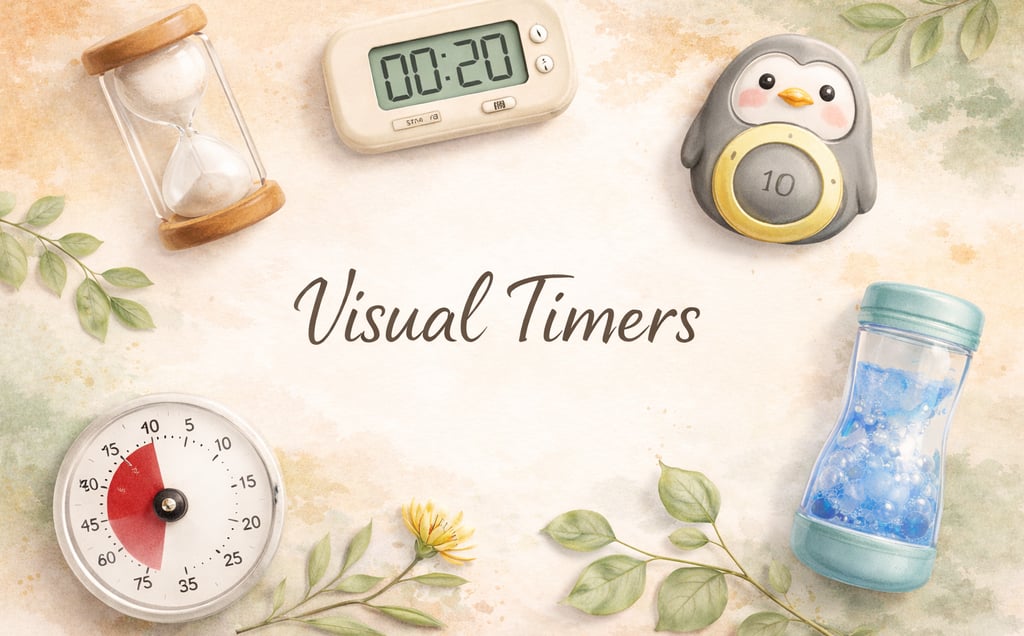

If you’ve ever said, “Okay, we’re leaving in five minutes!”… and your child continued on as if you had whispered into the void… You are definitely not alone. Truly. I think half of us parents live permanently in “We have to go now — I said five minutes ago!” mode 😊
But here’s the thing nobody really explained to us at first:
Time is invisible.
And invisible things are incredibly hard for many autistic and sensory-sensitive kids to process.
So when we say “You’ve got two more minutes…” what some kids actually hear is:
Something is changing soon. I don’t know when. I’m not ready.
And honestly? That’s stressful. No wonder transitions can sometimes turn into tears, panic, or full-body resistance.
This is where visual timers quietly make such a difference.
This post may contain affiliate links. If you decide to explore them, I may earn a small commission at no additional cost to you. Thank you for being here and for supporting this gentle space — it allows me to keep sharing real-life experiences and comforting resources for families like ours.
Why Visual Timers Help So Much
Visual timers don’t nag, rush, or pressure. They simply show time passing in a way kids can actually understand.
Instead of guessing, they can see:
colour disappearing
sand falling
numbers counting down
That predictability matters. A lot.
For many kids, it means:
less anxiety
fewer power struggles
smoother transitions
a calmer nervous system
And for parents?
It often means less repeating ourselves and a little more breathing room.
A Little Personal Note From Our Home
In our house, visual timers became one of those tools I didn’t realize we needed until we tried them.
My son is non-verbal autistic. He doesn’t use spoken words, but he communicates in his own ways — through pointing, sounds, body language, and clear preferences.
He uses both a sand timer and a digital visual timer, and he genuinely connects with them.
For short tasks, the sand timer works beautifully. He will watch the sand fall, completely focused, and when it runs out, the transition feels expected instead of upsetting.
For longer activities, he prefers a digital visual timer where he can clearly see time counting down on the screen. There is something comforting about knowing exactly how much time is left .... no guessing, no sudden endings.
Over time, he has learned how to let me know he wants the timer — sometimes by pointing to it, sometimes by bringing it to me, sometimes by standing near it and looking at me. It’s his way of saying, “Help me understand what’s next.”
That moment mattered to me. Because it reminded me that communication doesn’t have to look a certain way to be meaningful, and that visual tools can support non-verbal kids just as powerfully as verbal ones.
A Quick Note on the “Why”
Many autistic kids experience:
difficulty shifting attention
anxiety when something suddenly ends
time blindness
sensory overload during change
So when an activity stops abruptly, the brain can react as if control has been taken away, even if the activity itself wasn’t a big deal.
Visual timers gently hand some of that control back.
Everyday Moments Where Visual Timers Can Help
Visual timers can be helpful for:
ending screen time
finishing play
getting dressed
bath time
leaving the house
homework or focused tasks
bedtime routines
They don’t make transitions perfect, but they often make them easier.
Types of Visual Timers Families Often Find Helpful
I have included a few visual timers below in case you would like to explore them on Amazon. Every child is different, and that’s okay, so feel free to choose the one that feels like the best fit for you and your child.
Colour-Based Visual Timers
⏳Quiet, simple, and easy to understand at a glance.
Sand Timers
⏳Calming, visual, and perfect for short tasks.
Digital Visual Timers
⏳Great for longer activities and kids who like clear structure.
Timers With Gentle Alerts
⏳Soft cues for kids who benefit from a signal without startling sounds.
A Little Humour ...... Because We All Need It
Visual timers will not magically:
make your child leap up joyfully when time is up
turn mornings into a peaceful, candle-lit routine
stop you from reminding everyone one more time anyway
They also won’t:
eliminate every meltdown
make transitions instantly easy
transform anyone into a Pinterest-perfect parent who never forgets shoes, snacks, or library books
But they can:
reduce that sudden “no-warning” panic
help kids mentally prepare for what’s next
lower household tension just enough to breathe
make transitions feel more predictable — and therefore safer
And honestly? For many families, that’s more than enough.
Gentle Tips for Using Visual Timers
Introduce them during a calm moment
Use simple, clear language
Let your child watch the timer as time passes
Stay consistent, but flexible
Celebrate effort, not perfection
The goal isn’t obedience.
It’s emotional safety.
A Gentle Word About Investing in Tools
You don’t need a visual timer to be a good parent. You already are.
But if transitions feel heavy in your home, and you’re looking for something that supports rather than pressures your child, visual timers are one of those tools that often earn their place quickly.
If you choose to explore the timers linked above, thank you. Supporting this page helps me continue creating gentle, judgment-free content for autism families like ours.
You’re Doing Better Than You Think
If transitions are hard in your home, it’s not because you are failing. It’s because your child’s nervous system needs more support, and you are showing up to provide it.
That’s love in action.
And you’re always welcome here.