
When Words Won’t Come: Practical Tools That Help Nonverbal Autistic Kids Communicate
Learn how to communicate with a nonverbal autistic child using visual supports, AAC tools, and sensory strategies that reduce frustration.
2/20/20264 min read

If you read my post earlier this week about what “nonverbal” really means, then you already know something very important.
Nonverbal does not mean “nothing to say.”
It means the words just don’t come out the way we expect them to.
But let’s be honest for a minute.
Understanding that truth in your heart and living it in real time at 5:47 pm when your child is melting down because you handed them the wrong cup are two very different experiences.
I can tell you from my own kitchen floor moments with my son, the hardest part is not that he doesn’t speak. The hardest part is knowing he is trying to communicate and feeling like I’m missing it.
And that hurts.
So today I want to talk parent to parent. Like we are sitting across from each other at the kitchen table, trying to figure this out together. No clinical language. No pressure. Just real tools that have helped reduce frustration in our home. Tools that make communication feel possible instead of impossible.
Because sometimes we don’t need perfection. We just need progress.
A Small Note From My Heart Before We Begin
Before I share the tools that have helped us, I want to say this gently and openly.
Some of the links below are affiliate links. That simply means if you decide to purchase through them, I may earn a small commission at no extra cost to you.
I only share tools we have used, researched deeply, or would genuinely recommend to a close friend sitting across from me.
Running this blog allows me to stay home, support my children, and continue creating resources for autism families like ours. So when you choose to use one of my links, you are not just buying a product. You are supporting a mama who is building something meaningful for her kids and for this community.
Thank you for supporting my little cozy corner of the internet. It truly helps me continue sharing gentle, comforting finds for families like yours. 💚
“I Know He Wants Something… I Just Don’t Know What”
You know that look.
The pacing. The pointing. The frustration building in their little body while you are playing detective trying to guess what they need.
Snack?
Water?
Tablet?
Different snack?
The other cup?
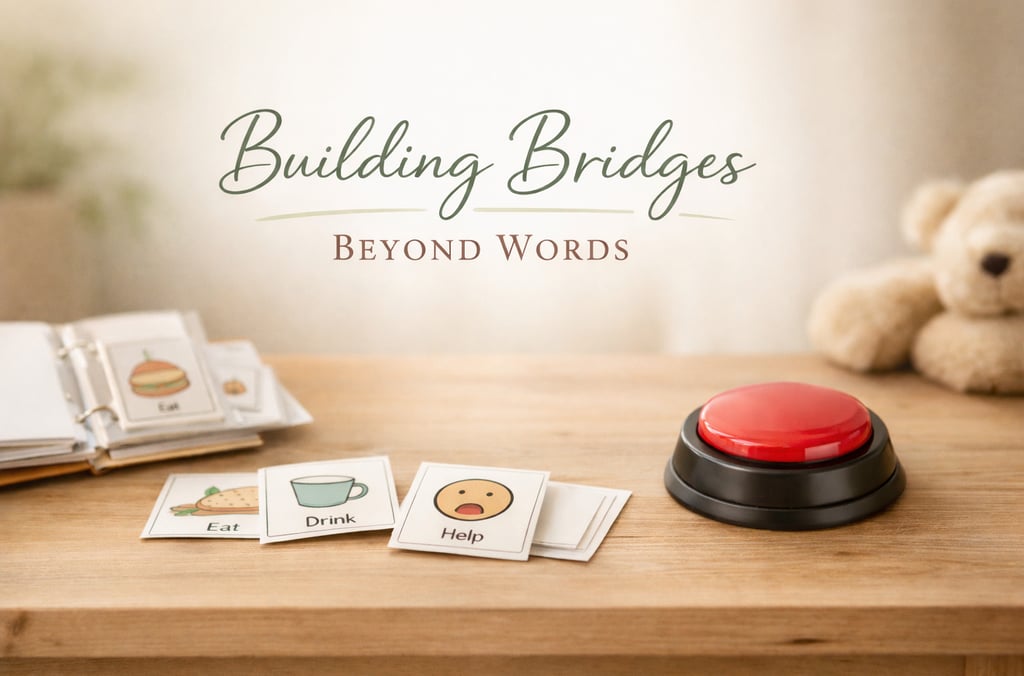
One of the first things that genuinely shifted things for us was introducing simple visual communication cards.
Not complicated. Not fancy. Just pictures he could point to or hand to me.
We started with basic needs. Eat. Drink. Bathroom. Break. Help.
Suddenly, I wasn’t guessing. He wasn’t escalating as fast. We had something concrete between us.
If you are just starting out, something like a PECS communication card starter kit
You can also grab blank laminated options like these laminated visual communication cards
The point is not perfection. The point is giving your child a bridge.
When Meltdowns Start Because They Can’t Say It
Sometimes the meltdown is not about the snack.
It is about not being able to say “help.”
That realization hit me hard.
We tried a recordable speech button
The first time he pressed it instead of screaming, I almost cried.
There are also beginner-friendly options like a BigMack communication button
No tool is magic. But giving your child even one consistent way to communicate reduces panic. And less panic means fewer explosions.
And honestly, fewer explosions means less of us crying in the bathroom afterwards.
“He Understands… But He Freezes”
When I would ask, “What do you want?” he would just look at me.
It was not that he did not know. The question was too open.
So I changed it.
Instead of “What do you want?” I started saying, “This or this?” while showing two pictures.
Choice boards have been incredibly helpful. You can use a simple autism choice board
Or even a small dry-erase communication board
Two choices feel safe. Ten choices feel overwhelming.
Sometimes simplifying the world is the kindest thing we can do.
When It’s Not About Communication… It’s About Regulation
Sometimes our children cannot communicate because their nervous system is overloaded.
No tool will work if their body is in fight or flight.
Weighted items have helped us so much. A simple weighted lap pad for kids
Noise sensitivity was also huge for us. A pair of noise-cancelling headphones for autistic kids
We also use sensory supports like a chewelry sensory necklace
Communication improves when regulation improves.
That one sentence changed how I parent.
And When You Feel Like Nothing Is Working
Now I want to speak to you.
Not as a blogger. Not as someone sharing tools.
As a mom who has had those nights where nothing worked.
You tried the cards.
You tried the button.
You tried staying calm.
You tried deep breaths.
And still everything felt like too much.
That is exactly why I created something small but meaningful for parents like us.
It is called When Nothing Works — A Gentle Parent Reset.
It is a calm, printable reset designed specifically for overwhelmed autism parents. The kind of reset you can use after a hard day or even in the middle of one. A few grounding prompts. A few steadying reminders. A quiet pause for your nervous system.
Because sometimes our children need tools.
And sometimes we do too.
If you need that kind of pause, you can find it here.
It is simple. It is soft. And it was created from lived experience.
If You Are Walking This Road Too
If you are in the thick of it right now, trying to decode tears, gestures, and big feelings, I want you to know something.
You are not failing.
You are learning a new language.
And your child is learning it with you.
There is no perfect system. There is no overnight transformation. But there are small tools that can soften the hard edges of the day.
And sometimes softer is enough.
If you have not read my earlier post about what “nonverbal” really means, I encourage you to go back and read it. It might change how you see your child’s efforts in ways you did not expect.
We are building connection here. Slowly. Imperfectly. Lovingly.
And that matters more than perfect words ever could. 💚