
When Your Autistic Child Won’t Leave the House: Gentle Support for Anxiety, Sensory Overload, and Overwhelm
When your autistic child refuses to leave the house, it can feel exhausting and confusing. This gentle guide helps parents understand anxiety, sensory overload, and simple ways to support overwhelmed kids.
3/19/20265 min read

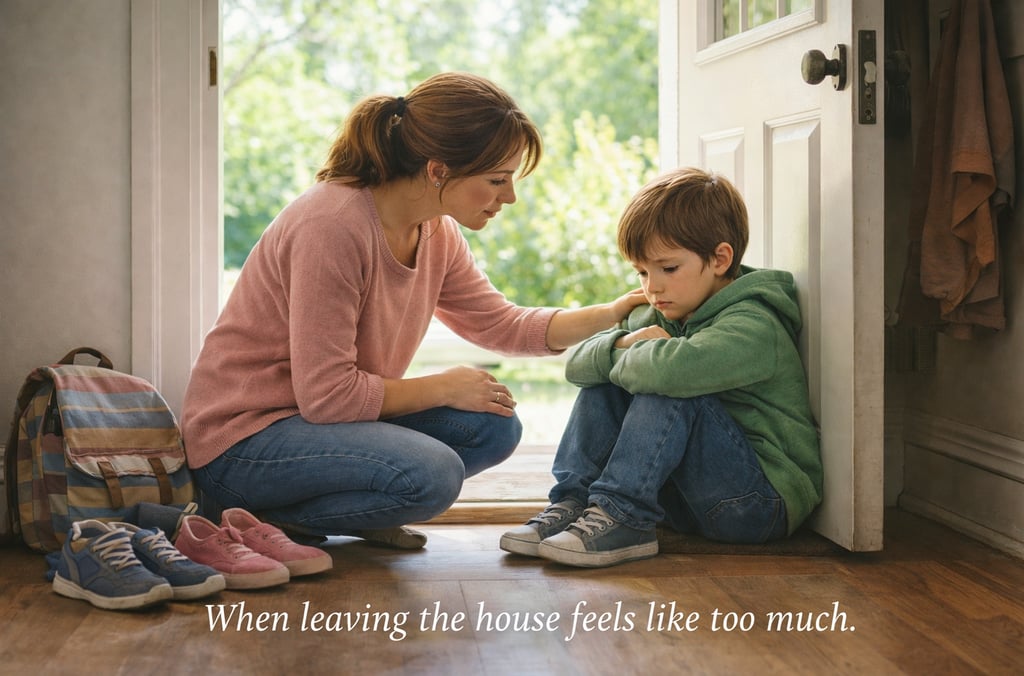
Let’s talk about one of those parenting moments that can make you want to laugh, cry, and question your life choices all at the same time.
You know the moment.
Your shoes are on.
Your bag is packed.
You’ve finally managed to get everyone somewhat dressed.
And your child suddenly decides that leaving the house is absolutely, positively not happening today.
You try the usual things.
“Come on sweetie, we just need to go to the store.”
Silence.
You try again.
“We’ll only be a few minutes.”
Still no movement.
Now you’re standing by the door, holding your keys, wondering how a simple outing somehow turned into a full emotional standoff with a three foot tall human.
If this sounds familiar, please know something important.
You are not the only parent standing at their front door having this exact moment.
And more importantly, your child probably isn’t trying to make your life difficult.
Something deeper is usually going on.
Sometimes “I won’t go” really means “this feels like too much”
When people picture a child refusing to leave the house, they sometimes assume the child is just being stubborn.
But with many autistic children, leaving the house can feel like stepping into chaos.
Home is predictable.
Outside is not.
At home your child knows where everything is. They know the sounds, the lighting, the routine, the smells. Their body feels safe there.
But stepping outside can suddenly mean:
Bright sunlight
Cold air hitting their skin
Cars driving by
Unexpected noises
New people
New smells
A place they can’t fully control
And all of that can feel overwhelming before you’ve even reached the driveway.
Sometimes when a child says “I don’t want to go,” what their nervous system is really saying is:
“This feels like too much for me right now.”
The leaving-the-house struggle most parents never talk about
One thing I’ve learned talking to other autism parents is that so many of us go through this, but we rarely talk about it openly.
We see other families out and about and assume everyone else has it figured out.
Meanwhile we’re negotiating with our child about putting on socks like it’s an international peace treaty.
And sometimes the stress builds quickly.
You might be thinking about the appointment you’re already late for.
Or the groceries you need.
Or the errands that simply cannot wait.
Meanwhile your child is sitting on the floor because the idea of putting on shoes feels like the end of the world.
Parenting in those moments can feel incredibly lonely.
Why leaving the house can feel so overwhelming
Every child is different, but there are a few common reasons this struggle shows up.
Sensory overload can start before you even leave
Sometimes the stress starts with something small.
The socks feel wrong.
The shirt tag is itchy.
The sunlight through the window feels too bright.
Even something simple like putting on a jacket can feel uncomfortable for a child whose nervous system is already sensitive.
By the time you’re ready to walk out the door, your child may already feel overloaded.
Transitions are hard
Many autistic children struggle with transitions.
Going from one activity to another can feel abrupt and unsettling.
Imagine being deeply focused on something you enjoy, and suddenly someone says,
“Okay, stop everything, we’re leaving now.”
That shift can feel very intense.
The outside world is unpredictable
Home feels safe because it’s familiar.
Outside is full of unknowns.
Children may worry about things like:
Who will be there
How loud it will be
How long they’ll have to stay
Whether something uncomfortable will happen
Even if they can’t explain these worries, their body may still feel them.
Sometimes their nervous system is simply tired
Autistic kids often carry a lot of sensory and emotional load during the day.
School, social interactions, bright lights, noise, expectations, transitions. It adds up.
Some days their capacity is just lower.
And on those days, even a simple outing can feel impossible.
Signs your child may be overwhelmed, not defiant
Parents know the difference between a typical “I don’t want to” moment and something deeper.
Some signs your child may be overwhelmed include:
Hiding when it’s time to leave
Crying when shoes or jackets come out
Suddenly becoming very rigid or upset
Running away from the door
Shutting down and not responding
Asking lots of anxious questions
When you see these signs, it often means your child’s nervous system is struggling, not that they are trying to control the situation.
Gentle ways to make leaving the house easier
Now let’s talk about a few things that can help.
Not every strategy works for every child, but these small shifts can sometimes make a big difference.
Give lots of warning
Many autistic kids cope better when they know what’s coming.
Instead of suddenly announcing it’s time to go, try giving reminders ahead of time.
“In ten minutes we’re going to get ready to leave.”
Then again in five minutes.
Predictability can lower anxiety.
Break the process into tiny steps
Sometimes the whole idea of leaving feels overwhelming.
Instead of focusing on the entire outing, try focusing on one small step at a time.
First socks.
Then shoes.
Then standing by the door.
Then stepping outside for just a moment.
Small steps feel more manageable.
Validate before you try to move forward
This one can feel surprisingly powerful.
Instead of immediately pushing the situation forward, start by acknowledging how your child feels.
“I can see this feels really hard right now.”
“You’re not ready yet, are you?”
That small moment of understanding can help your child feel safer.
And when children feel safer, they often become more flexible.
Reduce sensory stress where you can
If you know certain things trigger discomfort, see if you can soften those areas.
Maybe softer clothing.
Maybe different shoes.
Maybe turning lights down before leaving.
Maybe creating a calmer environment before the transition.
Sometimes it’s the small sensory things that make the biggest difference.
Practice leaving without pressure
One of the most helpful things you can do is practice leaving the house when there is no real destination.
Walk to the mailbox.
Step outside for a minute.
Sit in the car without driving anywhere.
Then go back inside.
These tiny experiences help children rebuild the feeling that leaving the house is safe.
And parents, this part matters
If leaving the house is a struggle in your home right now, please hear this.
You are not failing.
You are parenting a child whose nervous system experiences the world differently.
That requires patience, creativity, flexibility, and an incredible amount of emotional energy.
Most people never see that part.
But it’s real.
And it’s hard work.
Sometimes the right sensory supports can make outings feel much safer for autistic kids. Next week, I’ll be sharing a few tools that many parents use to make leaving the house feel a little less overwhelming.
A gentle next step
Sometimes the right sensory supports can make outings feel a little safer and more manageable.
Things like calming headphones, small fidgets, or other sensory tools can help children regulate their bodies when the outside world feels overwhelming.
In my next post, I’ll be sharing a few sensory tools that many parents find helpful for anxious outings, especially when children struggle with transitions or new environments.
Sometimes the right support can turn a stressful outing into something that feels just a little bit easier.
And when you’re parenting an autistic child, sometimes “a little easier” is a very big win.